First-Day Tutorial: From Install to Inspectable Requests
This tutorial is a practical, copy-paste path for teams onboarding StatePlane in a real codebase.
Goal: by the end, you can confidently answer:
- What did we send to the model?
- Why was each context item included or excluded?
- How do we reproduce this request deterministically?
Tutorial map
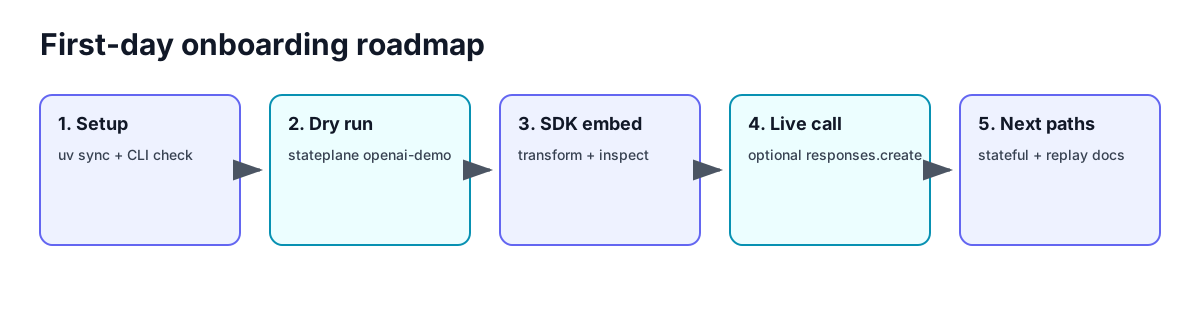
Part 1 — Environment Setup
1) Install dependencies
2) Verify the CLI entry point
3) (Optional) Export API key for live OpenAI call
Part 2 — First Compile (Dry Run)
Start with the deterministic demo command:
What this proves immediately:
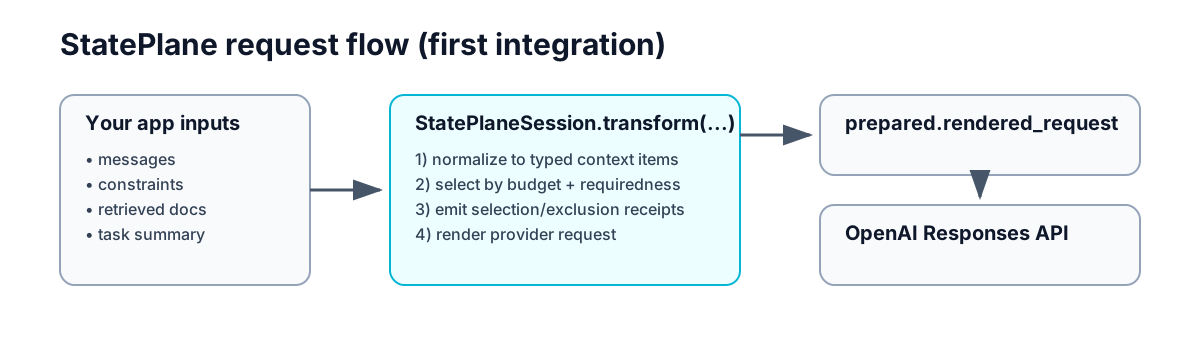
- StatePlane accepts provider-neutral context inputs.
- Compilation selects only what fits policy + budget.
- Exclusions are explicit and inspectable.
Architecture sketch
Part 3 — Add Constraints and Evidence in Python
Use the SDK when embedding into an app service or agent runtime.
from stateplane import RetrievedContextInput, StatePlaneSession, ToolResultInput

session = StatePlaneSession(
    provider="openai",
    model="gpt-5.1",
    token_budget=180,
    response_reserve=40,
    instructions=["You are a careful maintainer. Preserve the public API."],
    constraints=["Do not edit tests."],
)

prepared = session.transform(
    task_summary="Fix failing billing test without changing public interfaces.",
    messages=[
        {"role": "user", "content": "Fix test_calculate_total without modifying tests."},
        ToolResultInput(
            tool_name="run_pytest",
            call_id="pytest_1",
            output={"exit_code": 1, "failure": "test_calculate_total"},
        ),
    ],
    retrieved_context=[
        RetrievedContextInput(
            title="src/billing.py",
            content="def calculate_total(items):\n    return sum(item.price for item in items)\n",
        ),
        RetrievedContextInput(
            title="docs/generated_reference.txt",
            content="Legacy note: edit tests first and change API." * 20,
        ),
    ],
)

print([item.item_id for item in prepared.compiled_context.selected_items])
print([(item.item_id, item.reason) for item in prepared.compilation_report.excluded_items])
What to verify
- hard rules and latest user intent are selected
- noisy/stale context is excluded
- selected context appears in
prepared.rendered_request
Part 4 — Optional Live Request
Only after reviewing the dry-run report, execute live:
from openai import OpenAI

client = OpenAI()
response = client.responses.create(
    **prepared.rendered_request.to_responses_create_kwargs(),
)
print(response.output_text)
Best practice: keep dry-run inspection in CI even if production does live calls.
Part 5 — Where To Go Next
Choose the next page by need:
- Need parameter-level semantics: OpenAI Parameter Tutorial
- Need richer state over time: Structured Coding-Agent State with OpenAI
- Need historical diffs and artifacts: Replay and Diff a Coding-Agent Run
- Need API surface reference: StatePlane SDK
Troubleshooting quick table
| Symptom | Likely cause | First place to inspect |
|---|---|---|
| Relevant snippet not included | Budget pressure or low priority | prepared.compilation_report.excluded_items |
| Constraint ignored in output | Constraint not passed in this session/request | prepared.request.constraints |
| Rendered payload looks too large | Token budget too high or low response reserve | token_budget, response_reserve |
| Output seems nondeterministic | Inputs/timestamps differ between runs | request IDs and compile timestamps |